Wildfire smoke impacts New York ahead of World Cup final

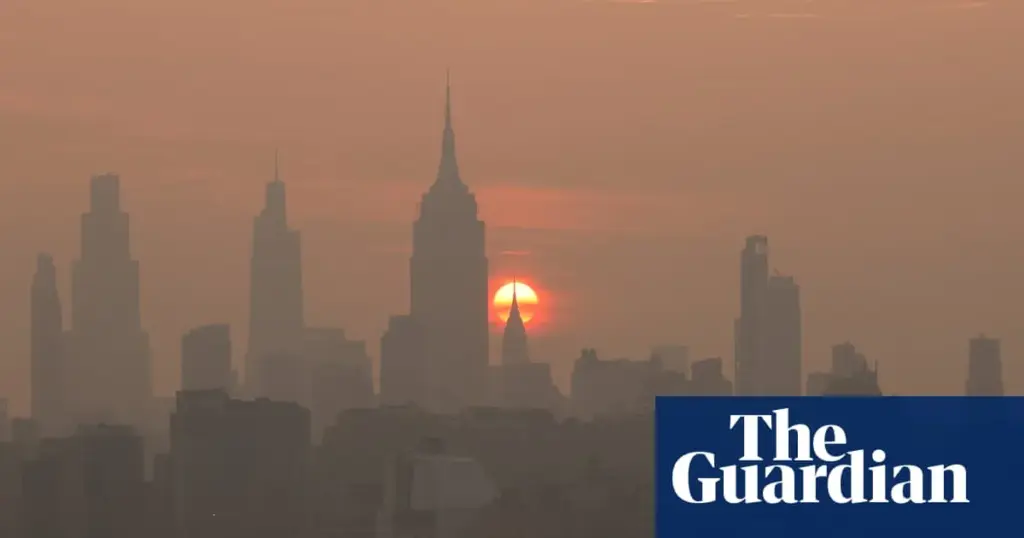
Dense wildfire smoke originating from Canada has led to unhealthy air quality alerts across various parts of the United States, raising concerns for the upcoming World Cup final scheduled outside New York. Cities such as Detroit and Chicago registered air quality index readings in the “hazardous” range, with one tracker identifying them among the world’s most polluted cities. The nation’s capital, Washington, also experienced significant impact, reaching a “very unhealthy” ranking where authorities advise avoiding non-essential outdoor activities.
In the New York metropolitan area, including New Jersey where the final will be held in an open stadium on Sunday, the air quality was deemed unhealthy for sensitive groups. This marked an improvement from Thursday, when smog was so thick that the Manhattan skyline was barely visible. However, forecasters from the National Weather Service have indicated that the smoke could intensify overnight into Saturday morning.
Impact on the World Cup Final
Organisers of the World Cup are closely monitoring the situation. Andrew Giuliani, executive director of the White House World Cup task force, confirmed that officials are tracking developments. Peter Mullinax, a meteorologist for the National Weather Service, noted that winds over the Great Lakes might push additional smoke into the Northeast, potentially maintaining hazy skies. Despite this, he suggested that forecasts for the region anticipate some improvement, indicating that the impact on Sunday’s game might not be as severe as if it were played earlier in the week.
The primary concern for Sunday’s match, according to Joel Dreessen, an air quality forecaster for Maryland, revolves around whether more smoke will drift south following weekend storm systems. Some models are beginning to suggest a southward movement of smoke. The thick smoke has been clearly visible in downtown Manhattan, obscuring landmarks like the Statue of Liberty and leading to flight cancellations at New Jersey‘s Newark airport.
Conditions began to improve on Friday, and officials are optimistic about further improvements by Sunday, especially with rain forecast for Saturday, which is hoped to clear the worst of the smoke. However, sports events have already been affected. A National Women’s Soccer League (NWSL) match between Gotham and Washington Spirit in Queens on Wednesday was played amidst an orange-brown haze, necessitating two additional breaks during each half in line with the NWSL‘s poor air policy.
The weather issues are particularly unfortunate for New York, a city that has embraced the World Cup. All seven previous games at the New York New Jersey Stadium have been sold out. Beyond the weather, another significant challenge for the final is accessibility to the stadium, which is known for limited public transport options and the complexities of navigating the Lincoln Tunnel connecting Manhattan with New Jersey.
Parking at the stadium on Sunday is restricted to guests and VIPs, and the cost of bus and rail travel for the tournament has seen a substantial increase. A joint intervention by the governments of New York and New Jersey, including a subsidy, has reduced the initial matchday return price for New Jersey Transit trains from $150 to $98, though this remains high for a 20-minute journey. Shuttle buses from Manhattan are available for $20.
Wildfires and Climate Change
In cities across the Midwest and Northeast, residents have been observed wearing masks outdoors to protect against the hazardous air. In New York, libraries and train stations have been distributing masks free of charge. The upper Midwest, closer to the fires, has been particularly affected, with parts of Michigan, Minnesota, and Wisconsin recording air quality readings deep within the “hazardous” range for several days.
The National Weather Service extended its air quality alert in Chicago through Friday, indicating that wildfire smoke might return on Saturday evening and persist into Sunday. Advocates have consistently highlighted the link between recurring episodes of wildfire smoke and climate change. Paul Mathewson, science program director at Clean Wisconsin, emphasised the importance of a swift transition to clean energy rather than expanding fossil fuel infrastructure that exacerbates climate change.
Mark Parrington, a scientist at the Copernicus Atmosphere Monitoring Service, stated that climate change is creating conditions conducive to a longer fire season, characterised by higher surface air temperatures and reduced soil moisture. This means that once ignited, fires can burn for weeks at a time throughout the summer. On Friday, the blazes in Canada intensified, with over 200 fires burning out of control, particularly in Ontario, according to authorities.
While the current damage is not as extensive as Canada‘s record-breaking 2023 wildfire season, when nearly 18 million hectares burned, the intensity has rapidly escalated over the past week. Nearly 2.8 million hectares have burned since the beginning of the year, an increase from approximately 1.6 million hectares as of the previous Friday. Fires in Ontario have not resulted in any casualties, though several remote communities have been evacuated.
Read Also
Source: rnz.co.nz

