Australian sprinters question new Commonwealth Games 100m qualifying rules


Commonwealth Games 100m qualifying draws criticism
Australian sprinters Rohan Browning and Eddie Nketia have voiced concerns regarding the new 100-metre qualifying system implemented at the Commonwealth Games. The updated rules, which were announced shortly before the athletics programme commenced, allow the top eight sprinters in the rankings to bypass the heats and proceed directly to the semi-finals. This change diverges from the traditional format where all athletes participate in heats, with automatic qualification typically granted to the top two finishers in each race.
The remaining competitors, including Browning and Nketia, were required to compete in a mass time trial across 11 heats. Browning, who finished second in his heat with a time of 10.24 seconds, described the new progression system as “unheard of” and “extremely weird.” He expressed confusion about his standing in the placings due to the altered format, noting the impact of gusty conditions on race times.
Browning highlighted that some heats might benefit from better weather conditions than others, creating an uneven playing field. He questioned the fairness of a system where a select group advances automatically, while others must qualify based on times in varying conditions. He also pointed out that athletes typically prepare for three rounds of competition, and the new rules mean some, like countryman Lachie Kennedy, do not have to run in the heats.
Kennedy, for instance, was granted a direct pass into the semi-finals as one of the seven fastest runners of the season. Browning stated, “It’s not fair, clearly it’s not fair,” suggesting the decision might have been engineered to achieve a specific outcome. He believes that most people would agree on the unfairness of the new system.

Sprinters navigate new system
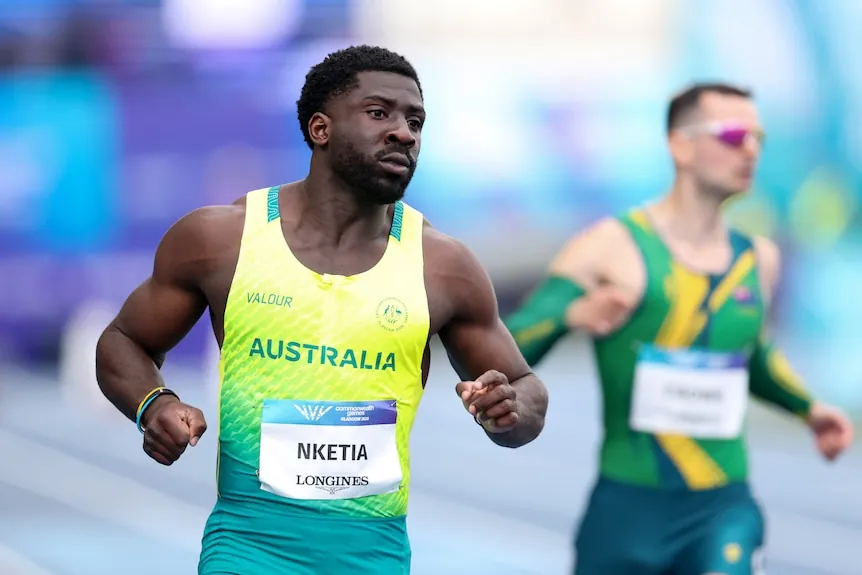
Despite his reservations, Browning successfully made the cut, qualifying in 16th position as the second slowest qualifier. His compatriot, Eddie Nketia, secured his spot as the fourth fastest overall with a time of 10.07 seconds. Nketia’s heat performance was aided by a significant tailwind of +3.9 m/s, which is considered illegal. This tailwind was a central point of Browning’s concerns, as it provided a clear advantage to runners in certain heats.
Nketia, however, adopted a pragmatic approach, stating that the situation was beyond his control and he would not dwell on it. He focused on his execution, aiming to perform well regardless of the rules. He described his 10.07-second run as “amazing,” akin to college conditions, and expressed anticipation for the semi-finals.
Browning acknowledged that the best response to the new rules is to run fast, adhering to the principle of meritocracy in the sport. He conceded that those who earned direct qualification likely deserved their spots, being the ones most probable to reach the final regardless. However, he also noted that factors such as injuries or form could affect athletes, and the timing of the performances used for automatic qualification was unclear.
National record holder Torrie Lewis is experiencing both aspects of the new system in the women’s events. While she competed in the heats for the 100m, she received automatic progression for the 200m event. Lewis expressed satisfaction with having a day off in between races, winning her heat in 11.15 seconds to become the second-fastest qualifier. She also mentioned that a direct qualification based on position rather than time would have been preferable to mitigate the impact of gusty wind conditions.

Impact on competition and future rounds
The new rules have introduced an element of unpredictability, with Browning noting that a slow heat could potentially prevent all runners from that heat from advancing, even if they finish in top positions. This contrasts with the traditional system where the top two from each heat would automatically progress.
The semi-finals and final for the 100m event are scheduled to take place on Wednesday morning (AEST).
Source: abc.net.au

